Should you worry about mushrooms or fungus on your tree?
Fungus on a tree is not always dangerous and not always harmless. We worry most when it grows from the trunk, base, roots, or a main limb, especially where the tree could hit people, a house, a drive, a road, or a boundary.
A few mushrooms in the lawn near a tree can be part of normal soil activity. Fungus on an old stump can also be part of the wood breaking down. Those cases still deserve a look, but they do not mean the standing tree is unsafe.
Location matters first. The question we ask is not “what colour is it?” but “which part of the tree is it growing from?” A tree with fungus may need watching, pruning, crown work, stump grinding, or removal. It depends on the tree’s condition and what sits within reach if a branch or stem failed.
Keep your first check simple and safe. Stay on the ground, look at where the fungus is growing, and avoid poking, cutting, scraping, or climbing.
The fungus location is the first clue
Where the fungus grows tells us far more at the start than its exact name. Use this as a first look, not a diagnosis.
- Fungus in the lawn or soil nearby Mushrooms near a tree do not automatically mean the tree itself is diseased. We look for any link to roots, dead wood, or an old stump before treating it as a tree safety issue.
- Fungus on a dead stump Growth on a stump is often part of decay. The main question is whether the stump and roots are simply rotting away, or whether nearby living trees are showing problems too.
- Fungus at the base or root flare The root flare is the part where the trunk widens into the main roots. Fungus here needs more care because this area helps hold the tree upright.
- Fungus on the trunk Bracket fungus or soft growth on a living trunk can point to decay inside the wood. We look at the whole stem, any old wounds, and whether the crown above it looks healthy.
- Fungus on a main branch or large limb Growth on a main limb matters more if that limb reaches over a path, garden seating area, drive, or boundary. The concern is the strength of that limb, as well as the fungus you can see.
A ground-level look gives you a sensible starting point. If the fungus is on dead wood or soil, the next move may be simple. If it is on a main support point, the tree needs a closer look.
We are a family-run team covering North Hertfordshire and Central Bedfordshire. Ask us for a free quote.
Get a Free QuoteWhy bracket fungus and honey fungus are not the same problem
Bracket fungus and honey fungus are different problems, so one label does not tell the whole story. At Treescapes, we look at the whole tree, and we do not focus on the fungus alone.
| What you may see | What it can mean | What we check |
|---|---|---|
| Bracket fungus on a trunk or branch | Decay in the central wood, without proving the living parts are dead | The stem, old wounds, crown condition, and what the tree could hit |
| Honey fungus in the garden | Possible root or stump infection, including growth from hidden woody material | Roots, dead stump material, nearby plants, and signs of decline |
| Mushrooms away from the trunk | Fungi growing from soil, dead roots, or buried wood | Whether the standing tree shows any other warning signs |
The Royal Horticultural Society explains that many bracket fungi decay the central wood of a tree and do not kill the living parts directly. That is why a bracket does not automatically mean the tree is finished, but it does mean the strength of the wood may need checking.
Honey fungus is handled differently. Its mushrooms can appear in late summer or autumn around dead stumps, over dead roots, or from black cord-like growths in the soil called rhizomorphs, often known as bootlaces. The Royal Horticultural Society also says there are no chemicals available to control honey fungus, so spraying random treatments is not a cure.
Scraping off a bracket is no answer either. It may remove the visible sign, but it does not tell you what is happening inside the wood. Poor pruning can also create wounds, and pruning that exposes central wood can make bracket fungus infection more likely.
Check whether the fungus is growing from soil, dead wood, or a living part of the tree before you do anything else. That one detail often tells you whether the issue is routine decay or something that needs a closer look.
The signs that make tree fungus more serious
Fungus on a stump is a very different sight from fungus at the base of a leaning tree with dead branches above a drive. The fungus is one clue, and the rest of the tree gives the context.
Tree changes that matter
Look at the crown first. Crown dieback means parts of the upper tree are thinning, dead, or failing to leaf properly. A few dead twigs are common on many trees, but larger dead limbs or a thinning crown alongside fungus make the issue more serious.
Ground-level changes deserve the same attention. Cracks, soft-looking wood, hollow areas, lifting roots, or a lean that has changed all point to a tree that needs proper inspection. Wind can expose weakness fast, especially on older garden trees around North Hertfordshire and Central Bedfordshire.
Position changes the practical risk. A declining tree at the back of an open garden is not the same as one over a public path, driveway, road, or neighbour’s boundary. We judge the tree and the target together.
Actions that do not solve it
Scraping off bracket fungus can hide the warning sign without dealing with the decay. Spraying a treatment at random wastes time and may delay the right decision.
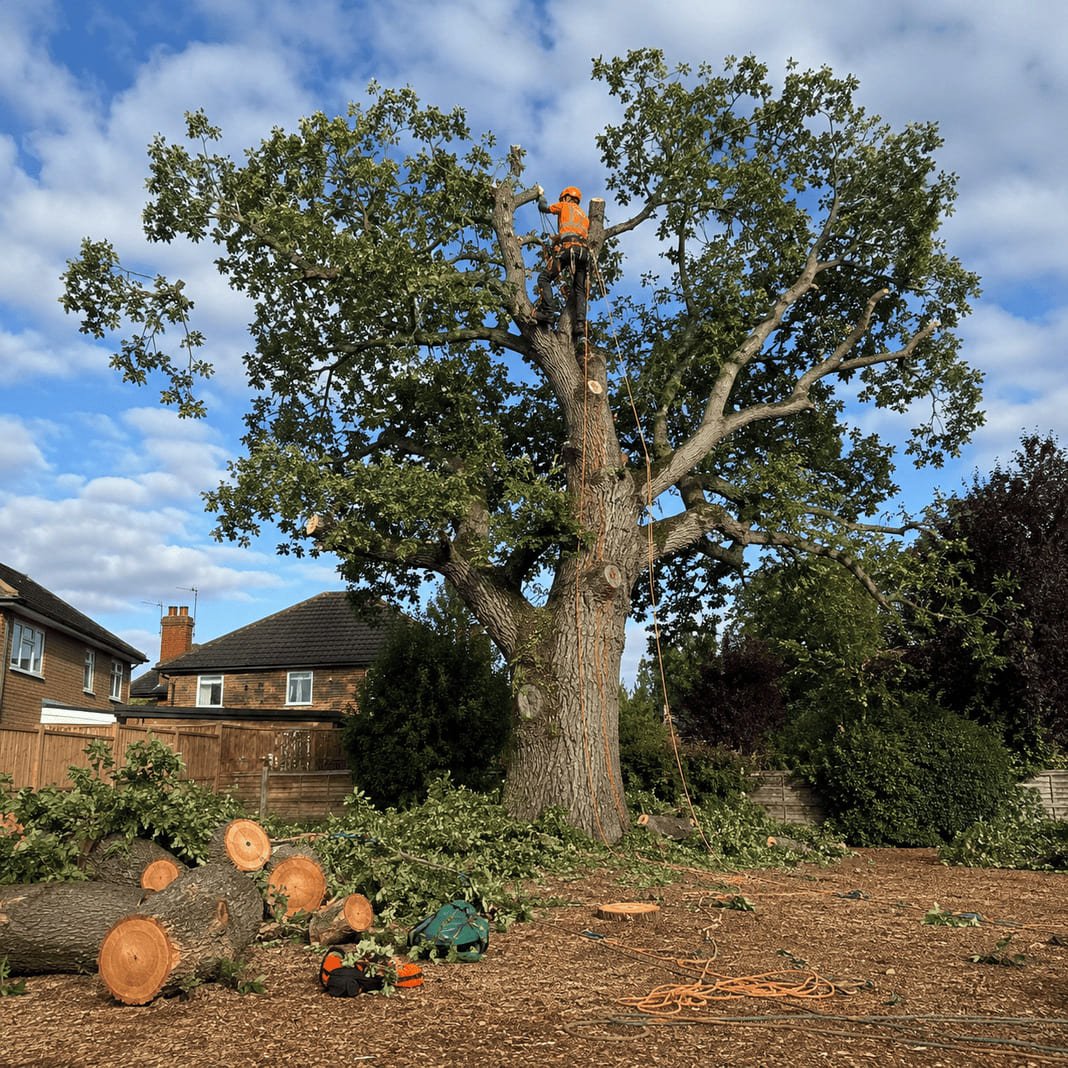
Cutting large limbs yourself is also a poor answer. Heavy branches behave unpredictably once cut, and the wrong cut can leave the tree weaker. A qualified arborist will decide whether pruning, crown reduction, crown thinning and lifting, or another option makes the tree safer while keeping as much sound growth as possible.
The safe response is inspection, not guesswork
When fungus sits on the trunk, base, roots, or a large limb, and the tree could hit something that matters, inspection is the safer route. Monitoring can be enough for low-risk dead wood or a stump, but structural parts need proper judgement.
We start with the parts that carry the tree: base, roots, trunk, and main limbs. Then we look at the crown, nearby targets, and whether the tree has changed since storms or high winds. The aim is to choose the least drastic safe option. That could mean pruning, reducing the crown, removing deadwood, grinding a stump, or, where needed, removing the tree.
Treescapes is based near Henlow and works across North Hertfordshire and Central Bedfordshire, so local tree protection rules come up often with mature garden trees and conservation areas. Some trees are covered by a Tree Preservation Order, and GOV.UK guidance says work on those trees usually needs local planning authority consent unless an exemption applies. Conservation area tree work can also require notice unless an exception applies, so the safe habit is to check your council before work starts.
Permission checks should sit alongside the tree inspection, not after someone has already cut the tree. That is especially true where a tree looks diseased or dead, because protection rules can still apply.
If the tree has fungus and also shows crown dieback, cracks, a lean, or lifting roots, treat it as a higher concern. Those signs together mean the tree needs proper inspection rather than a quick visual guess.

The clearer way to look at mushrooms on your tree
A mushroom is a clue, not a verdict. Once you stop trying to decide everything from its shape and colour, the problem becomes easier to sort.
Start with location. Soil or stump growth is usually a lower concern than fungus on the base, trunk, roots, or main limbs. Then look at the tree around it: crown condition, cracks, lean, deadwood, and what the tree could hit. Those details tell you whether watching is sensible or whether a tree surgeon needs to inspect it.
Good tree care avoids panic felling and careless delay. The right answer may be to keep the tree with careful pruning, reduce risk with crown work, deal with a stump, or remove a tree that cannot be made safe. Once you know what to check, you are no longer guessing from a mushroom alone.
Tell us what you need and we will give you a free, no-obligation quote, usually within 24 hours.
Request a QuoteQuestions we get asked about tree fungus
Is fungus on a tree stump a problem?
Fungus on a stump is often part of normal decay. We still look for nearby tree decline, because old roots and buried wood can sometimes be linked to other problems in the garden.
Can mushrooms in the lawn near a tree harm the tree?
Mushrooms in the lawn do not automatically mean the tree is diseased. The key point is whether they are growing from soil, dead roots, buried wood, or directly from living parts of the tree.
What is the root flare on a tree?
The root flare is the widened area at the bottom of the trunk where the main roots start. Fungus there matters because those roots and the lower trunk help support the tree.
Can a tree with fungus be saved?
A tree with fungus can sometimes be kept, but the answer depends on where the fungus is growing and how sound the tree is. Pruning or crown work may be enough in some cases, while removal is safer in others.
Do I need permission to remove a tree with fungus?
You may need permission if the tree is protected or sits in a conservation area. The rules depend on your council, so protection checks should happen before tree work starts unless there is an immediate safety issue.
This is general information, not professional advice.





