
Can you deal with a small tree yourself?
We treat light pruning on a small tree as a do-it-yourself job only when you can stand on the ground, use hand tools and make minor cuts. You need a tree surgeon when the work involves height, a chainsaw, heavy branches, crown reshaping, removal, nearby structures, cables or permission doubts.
Table of Contents
Define your small tree job clearly
One small tree might stand in open lawn with easy access all round. Another might lean over a fence, greenhouse, shed, car space or neighbour’s boundary. Those are very different jobs, even if both trees look modest from the kitchen window. “Small tree” is a loose garden phrase. It does not tell us enough about the risk, the tools or the likely mess. We look first at what you want the cut to achieve. Are you taking off dead twigs, clearing a branch from a path, reducing the whole crown, removing the tree, dealing with a stump or trying to clear a pile of branches afterwards? For pruning, the tree type and the aim matter. The Royal Horticultural Society says pruning can affect a tree’s size, shape and vigour, so it makes sense to know what you are cutting and why before you start. Dead, damaged, diseased, weak or rubbing branches are usually the first sensible targets. A light tidy can be a fair do-it-yourself, or DIY, tree pruning job. A bigger change to the shape of the tree is different. If the tree has simply outgrown its space, the best answer might be to do a little safe tidying now, then get advice before making heavier cuts.
Tree or Garden Job in Mind?
We are a family-run team covering North Hertfordshire and Central Bedfordshire. Ask us for a free quote.
Get a Free QuoteSeparate safe DIY from tree surgery
The line between safe DIY tree pruning and small tree surgery becomes clearer when you look at three things: where you stand, what tool you need and what happens when the branch falls. If any of those feels uncertain, pause before cutting.| Job | DIY line | Tree surgeon line |
|---|---|---|
| Light pruning | You can stand flat on the ground and use secateurs, loppers or a small pruning saw for minor growth. | Cuts are above comfortable reach, branches are heavy or you are changing the main shape of the crown. |
| Dead or rubbing branches | Small, easy branches can be removed if they are clearly within reach. | Larger dead wood can break badly, especially if decay has changed how the branch will move. |
| Crown reduction | A few light side shoots are one thing. | Reducing a crown means reshaping the tree as a whole, so it belongs with a qualified tree surgeon. |
| Small tree removal | A tiny self-set sapling in open ground may be simple garden work. | A leaning tree, tight garden, nearby structure, road, cable or neighbour issue makes removal controlled tree work. |
| Stump and waste | Light clippings can go with normal garden waste if your collection allows it. | Stump grinding, logs, heavy branches and large green waste piles need the right kit and lawful disposal. |
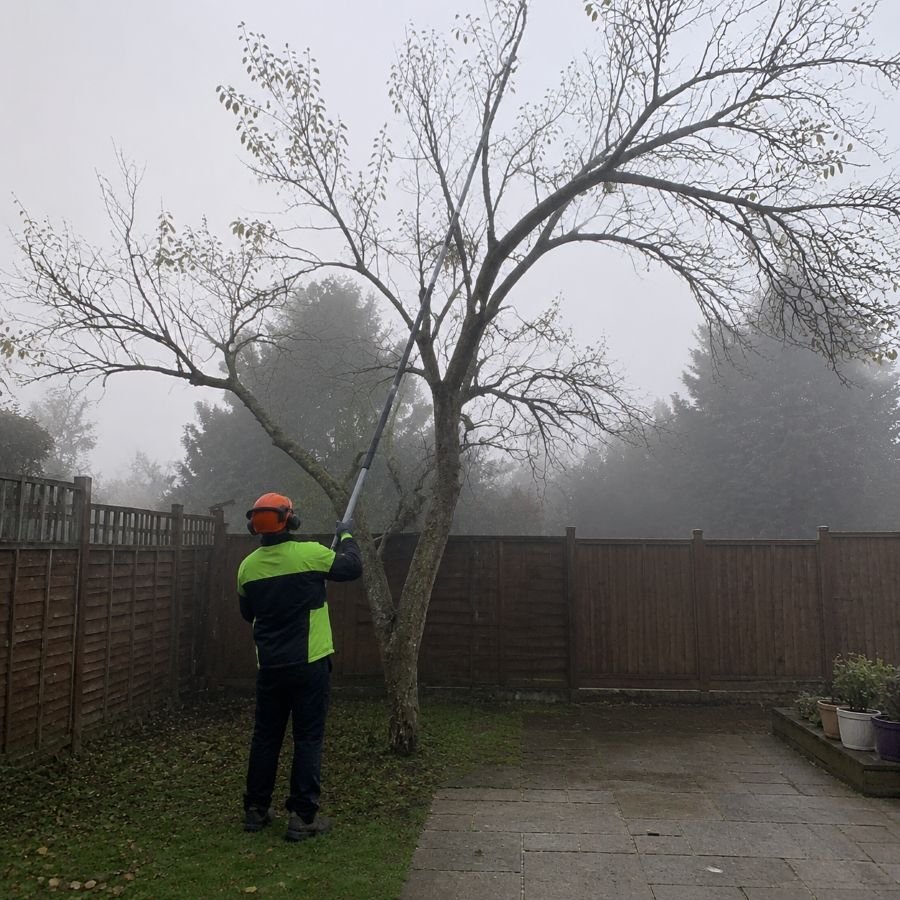
If the branch you want to cut would be hard to hold with one hand, treat it as a job that needs more than basic garden tools. That is often the point where clean-up and control matter as much as the cut itself.
Check permissions, timing and waste early
The cut itself might take less time than the checks and the clearing. Permission, timing and waste are the three things homeowners often think about too late, and they are also the things that turn a simple garden task into a stop-and-check job.Protected trees and council checks
Some garden trees are covered by a Tree Preservation Order, conservation area rules, planning conditions or another local planning authority process. GOV.UK says garden trees can fall outside some felling licence rules in some cases, but other controls can still apply. A protected tree is still likely to need council consent before felling. That matters locally because we work across North Hertfordshire and Central Bedfordshire, and the council process depends on where the tree stands. Treescapes Garden Services is based in Lower Stondon near Henlow, so we are used to checking the right route before work starts, instead of assuming one rule fits every garden.Nesting birds and timing
Pruning time depends on the tree type and the aim of the work. Some trees are better pruned at certain times, so one blanket month for every small garden tree is too blunt. Wildlife checks also matter. Under the Wildlife and Countryside Act 1981, active nests and protected wildlife must be handled properly, so work should be delayed if an active nest is present. That is a normal check, not a reason to panic or leave a tree forever.Branches, logs and clean-up
A small tree can still leave a large pile of branches, leafy waste and logs. If you only planned for the cutting, the clean-up can become the biggest part of the day. Before you cut, decide where the waste will go. We are licensed to carry waste, and 99% of our green and tree waste is recycled. On a small job, that matters because tidy work is partly about what happens after the saws and loppers are put away.
Check waste clearance before you prune. A small tree can still produce more branches and logs than a normal garden bin can handle, especially if you also want the area left tidy.

Use a stop-go check before cutting
Run this check before any tool comes out. Each answer should point you to one of three choices: do the light job yourself, pause and check, or bring in a qualified and insured tree surgeon.- Stand on the ground. If you can do the whole cut from firm ground with both feet down, the job may stay in DIY territory. If you need a ladder, platform or climbing, stop.
- Use hand tools only. Secateurs, loppers and a small pruning saw suit light pruning. A chainsaw changes the risk and belongs with trained people.
- Look at the branch weight. If the branch would be awkward to hold, drag or lower, treat it as professional work.
- Check what is nearby. Sheds, fences, glass, cars, roads, cables and neighbouring gardens all reduce your margin for error.
- Look at the tree’s condition. Cracks, decay, dead sections or a lean make the job harder to judge from the outside.
- Check permissions and wildlife first. If you are unsure about a Tree Preservation Order, a conservation area or active nests, pause before cutting.
- Plan the waste. If the branches will fill more space than you can clear safely, the job is bigger than it first looked.

Want Honest Advice and a Fair Price?
Tell us what you need and we will give you a free, no-obligation quote, usually within 24 hours.
Request a Quote




