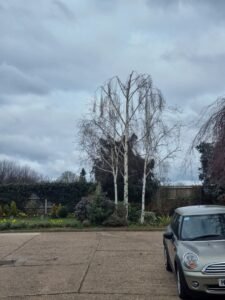
Is your leaning tree dangerous straight away?
A leaning tree is not automatically dangerous. We first look at whether the lean is old or new, whether the soil or roots have moved, and what the tree could hit if it failed. A stable garden tree may only need watching, but a recent or worsening lean needs checking.
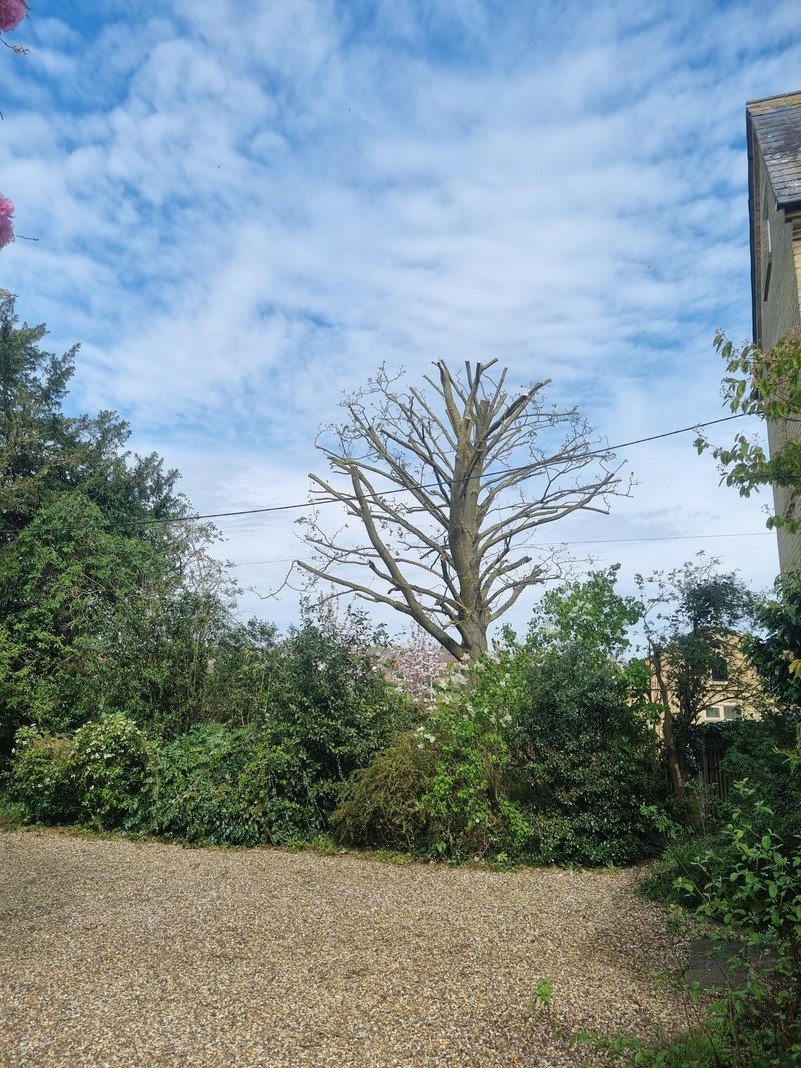
A leaning tree needs context before action
You notice a tree leaning over a fence, drive, roof or neighbour’s garden, and the first worry is simple: will a leaning tree fall? The honest answer is that the lean alone does not decide the risk. Some trees grow at an angle for years because of light, wind or crowded planting, and they can remain stable.
Risk rises when something has changed. A tree that starts leaning after high winds, heavy rain or ground movement deserves faster attention, especially if it points at a house, car, path, road or play area. Leaves and normal summer growth do not prove the structure is sound, because a tree can look alive and still have a problem at the roots or stem.
The National Tree Safety Group puts the general risk from trees at around 1 in 15 million, but it also makes clear that a particular tree can present high risk in rare cases. We treat that as the right balance for garden tree safety. Do not panic, but do not ignore obvious movement.
We are a family-run team covering North Hertfordshire and Central Bedfordshire. Ask us for a free quote.
Get a Free QuoteOld lean and new movement point to different risks
Change matters more than angle. A tree that has leaned the same way for years is a different concern from a tree suddenly leaning after weather or recent digging nearby.
Here is the plain way we separate a normal leaning tree from one that needs checking.
| Often normal | Needs checking |
|---|---|
| The tree has leaned the same way for years | The tree suddenly started leaning |
| Old photos show the same shape | The lean is getting worse |
| The ground around the base looks settled | Soil has cracked, lifted or sunk |
| Roots look firm in the ground | Roots are exposed or the root plate has moved |
| The crown is balanced enough for the site | The crown is heavy on one side |
| The tree leans over open garden space | The tree leans over a roof, drive, path or boundary |
No table can make a tree safe. We use it as a first filter because it stops the common mistake of judging the tree by how dramatic it looks. A long-standing lean can still need pruning if the crown has become side-heavy, and a recent small movement can matter if the tree now aims at something that could be damaged.
Older garden photos help more than people expect. Fence lines, patio gaps and a clear memory of where the trunk used to sit can show whether the tree has moved. If the story is “it has always been like that”, we look at stability and pruning options. If the story is “it changed after the last storm”, we treat it with more caution.
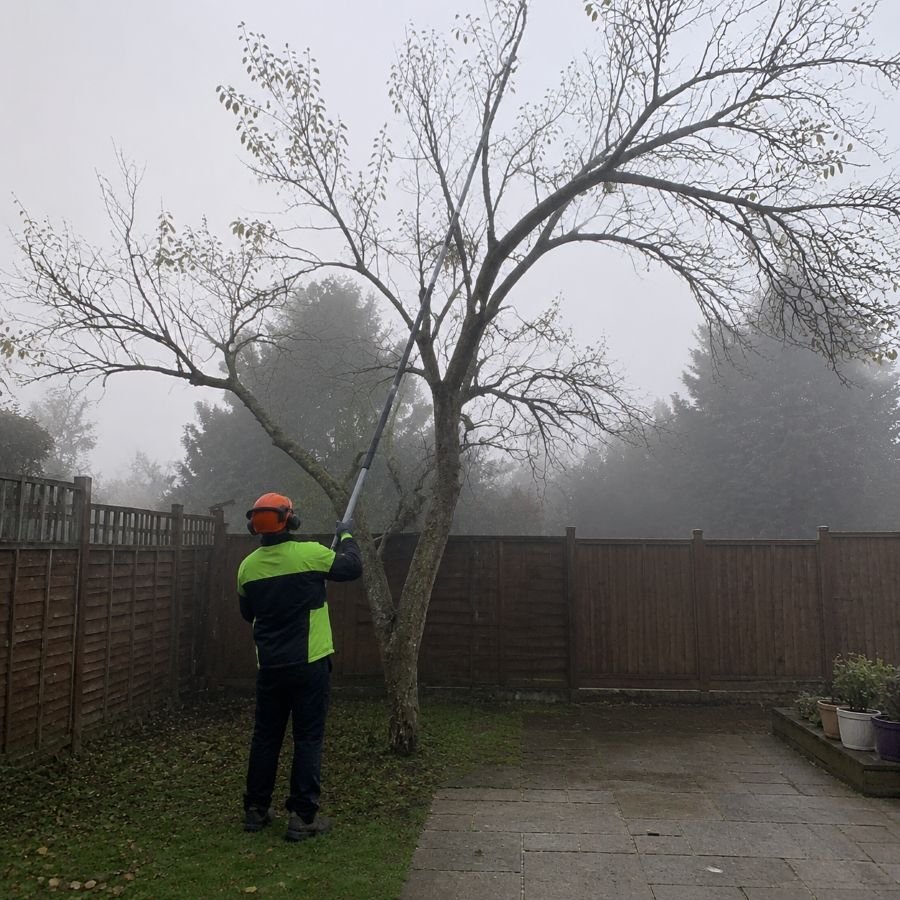
Old photos of the tree and boundary line can help you tell whether the lean is recent or long standing. That detail often matters more than the angle itself.
Ground-level checks give you useful clues
Stay on the ground and look only. Do not climb, cut, pull, dig around the roots or try to straighten a mature tree, because that can make the situation less safe.
Start at the base and work upward with your eyes.
- Soil around the base: Look for cracked soil, raised ground or a gap opening on one side of the trunk.
- Root plate: The root plate is the root and soil area that anchors the tree. Fresh lifting, exposed roots or a tilted base can be more serious than the visible lean.
- Main stem: Check for splits, large cavities or signs that the trunk has opened. Do not poke tools into holes or try to test the wood.
- Branch unions: Branch unions are the points where large limbs meet the stem. Cracks or fresh splitting here need attention.
- Crown shape: The crown is the branch and leaf area. Broken hanging limbs, dead branches or a very heavy one-sided crown can add load.
- Fungi near the base: Fungal growth does not always mean removal, but it is worth noting, especially with other signs.
- Target area: Look at what the tree would hit if it failed, such as a driveway, footpath, boundary fence, shed, roof or parked car.
Several signs together matter more than one feature on its own. A single dead branch on a stable tree might be a pruning job, but a leaning tree with lifted ground and a target beneath it needs a qualified arborist, which means a trained tree specialist, to assess it properly.
The National Tree Safety Group says homeowners should look for obvious features that could cause harm if a tree failed, and seek help from a competent tree specialist if they are unsure. We agree with that. Ground-level checking is useful because it tells you what to mention, without turning you into the person taking the risk.
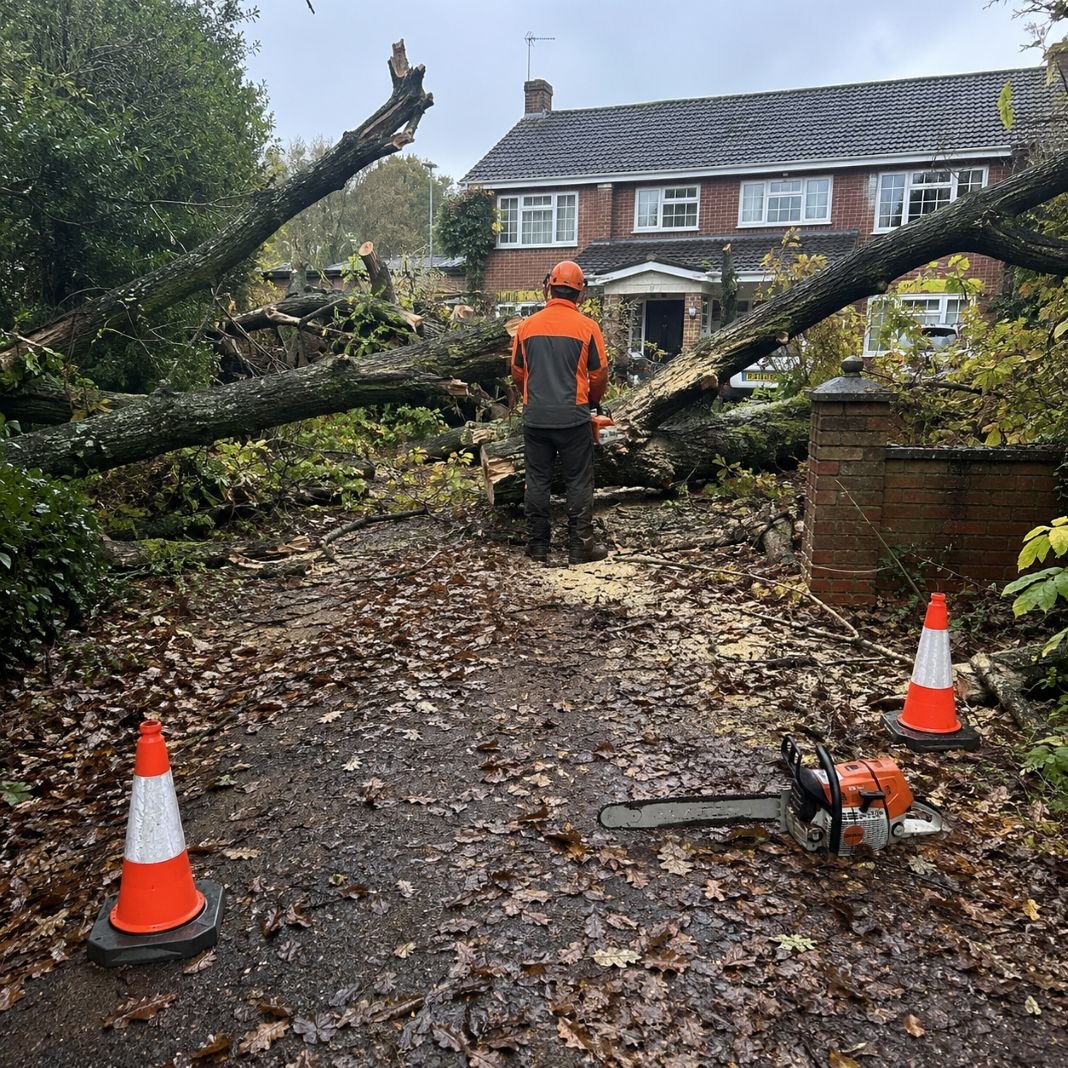
Weather and power lines change the decision
After high winds or heavy rain, a leaning tree deserves a quicker look from a safe distance. Wet ground can let roots shift, and wind can leave broken branches caught in the crown where you cannot see the full problem from below.
Target areas matter more after bad weather. A tree leaning over a quiet lawn is one kind of concern. A tree leaning over a drive used every day, a public footpath, a roof or a school area has a higher consequence if it fails. For gardens around Henlow, Shefford, Stotfold and the River Ivel valley, open ground, older boundaries and wetter pockets of soil can all affect how a tree behaves after storms.
Power lines are a hard stop for DIY work. The Health and Safety Executive says arboricultural work within 10 m of overhead power lines needs a risk-based approach, with specialist advice from the Network Operator, which is the organisation responsible for the local lines. Work farther away still needs thought if falling timber or debris could breach that distance.
Treescapes Garden Services is based near Henlow and works across North Hertfordshire and Central Bedfordshire, so we see the same worry in both town gardens and rural-edge plots. If electricity, storm movement or a high-use area is involved, the safe choice is to keep clear and have the tree assessed before anyone cuts or moves anything.
If a leaning tree sits near a roof, drive, path, or power line, keep clear of the fall area and have it assessed from the ground before any pruning or cutting.

A leaning tree can be managed, pruned or removed after assessment
“Can the tree be saved?” is a better question than “should it be cut down?” The answer depends on stability, movement and what sits under the likely fall line.
A stable tree may only need management
A stable leaning tree can sometimes stay where it is. Monitoring may be enough if the lean is long-standing, the ground is settled and the target area is low risk.
Pruning can also help where the tree is structurally sound but poorly shaped. Crown reduction can reduce overall size, crown thinning can lessen the density of selected branches, and crown lifting can raise lower branches for clearance. These are tree work decisions, not guesswork with a saw, because too much cutting can leave the tree worse off.
At Treescapes, we would rather assess whether careful pruning or crown work can manage the tree than rush to fell it. Joe, our fully qualified arborist, is on every job, and that matters most when the right answer is a measured cut rather than removal.
A moving tree needs expert judgement
Fresh movement changes the job. If the root plate has lifted, the soil has cracked, or the tree has shifted after wind or rain, we treat it as a safety assessment first.
Small young trees may sometimes be staked, but a mature leaning tree is not something to pull upright. The weight, roots and crown all need proper judgement. Removal is sometimes the right answer, especially where the tree is unstable or aimed at something that cannot be protected any other way. That decision should follow assessment.
Clear cost matters here too. Before work starts, you should know what is being done, what happens to the waste, and whether the site will be left tidy. Hidden extras make a worrying tree feel worse, so we keep the work and the price clear before tools come out.
Protected trees need permission checks
Protected tree rules can apply even when a tree looks unsafe. A Tree Preservation Order can restrict cutting down, topping, lopping, uprooting, wilful damage or destruction unless the local planning authority has given written consent.
Conservation area rules can also apply. GOV.UK describes the section 211 notice as the normal notice given to the local planning authority before certain tree work in a conservation area. Because our working area crosses North Hertfordshire and Central Bedfordshire, we check the correct council position for the property instead of assuming one rule covers every garden.
Once you separate the lean, the movement and the target, the tree stops being a vague worry. You know whether to monitor it, arrange pruning, keep people away from the fall line, or have it assessed before anything else happens.
Tell us what you need and we will give you a free, no-obligation quote, usually within 24 hours.
Request a QuoteQuestions we get asked about leaning garden trees
Can a leaning tree be saved?
Yes, a leaning tree can sometimes be kept if the lean is stable and the roots have not moved. Pruning, crown reduction or monitoring may be enough where the tree is otherwise sound.
How much lean is too much for a tree?
We do not use a fixed angle as a safety rule. A smaller lean with fresh root movement can be more worrying than a larger lean that has stayed the same for years.
Should I stake a leaning tree?
Staking may suit some small young trees, but mature leaning trees should not be treated as something you can straighten by force. A mature tree needs assessment before any attempt is made to alter its position.
Does green leaf growth mean my leaning tree is safe?
No, leaves show that parts of the tree are alive, but they do not prove that the roots, stem or branch unions are sound. Ground movement, cracks and what the tree could hit matter more for safety.
Who is responsible if my neighbour’s tree leans over my garden?
Responsibility depends on ownership and the situation, so it is best handled carefully. If you think the tree could fall into your garden, keep people away from the likely fall area and seek suitable professional advice.
This is general information, not professional advice.