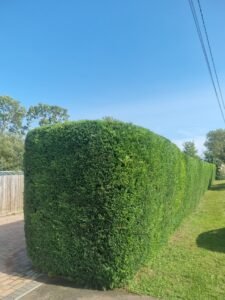
How often should you cut a hedge?
We start with the hedge’s style, then the plant. Informal hedges usually need one cut a year. Formal hedges may need one, two or three cuts, especially privet, laurel and conifers. Leylandii needs lighter, regular trimming because hard cuts into brown wood do not recover.
For established hedges that have reached the height and width you want, the Royal Horticultural Society’s maintenance guidance gives a useful starting point.
| Hedge type | Usual cutting frequency | Plain timing note |
|---|---|---|
| Informal mixed or flowering hedge | Usually once a year | Time the cut around flowering or fruiting |
| Privet | Two or three times during the growing season | Good for a neat formal boundary |
| Cherry laurel | Twice during the growing season | Trim lightly to hold shape |
| Box | Two or three times during the growing season | Best kept neat with light control |
| Holly | Once in late summer | Slow enough for one planned trim |
| Leyland cypress, also called leylandii | Two or three times during the growing season | Cut between April and the end of August |
| Lawson’s cypress | Twice in spring and summer | Keep the sides under control |
| Yew | Twice in summer and autumn | Suits careful shaping |
| Western red cedar | Twice, in spring and early autumn | Keep edges neat without hard cutting |
| Beech | Once in late summer | One good cut often holds it well |
| Hornbeam | Once in mid to late summer | Similar routine to beech |
| Hawthorn | Twice in summer and autumn | Useful where a sharper line is wanted |
Use that table as a maintenance guide, not a rescue plan for a hedge that has been left for years. A light trim on a tidy privet is very different from reducing an overwide conifer screen along a driveway.
Growth rate, finish and current condition still matter. If you want a crisp front boundary, you will cut more often than someone with a loose wildlife hedge at the back of the garden.
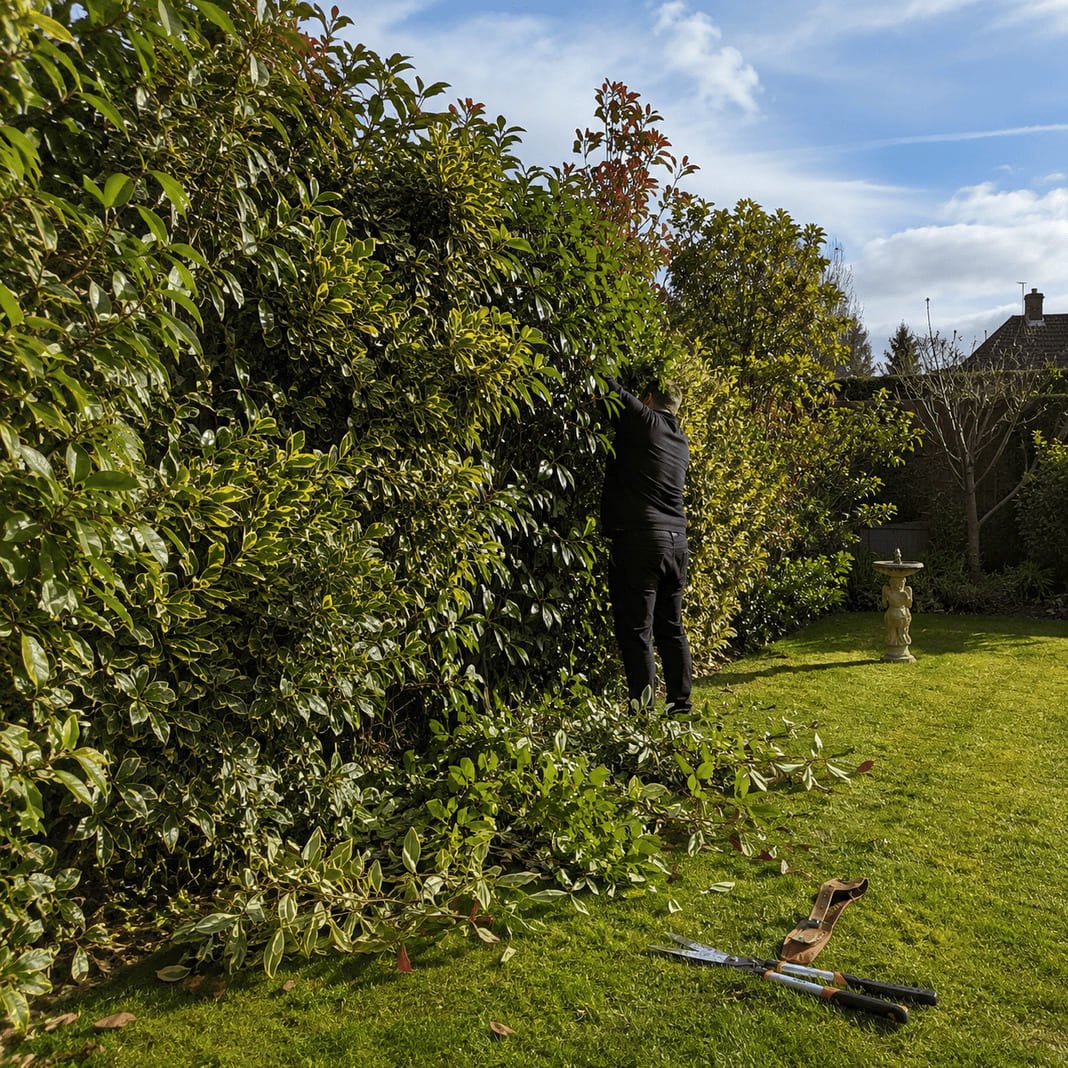
Hedge type changes the routine once the style is clear
A neat privet boundary and a thick leylandii screen can both be “hedges”, but they do not behave the same way under a trimmer. At Treescapes, we look at the plant first before deciding how hard and how often to cut, because one wrong heavy cut can leave a hedge looking worse for a long time.
Formal evergreen hedges need light, regular control
Privet, laurel, box and holly are often kept as formal hedges, which means you are managing a shape as much as a plant. Young growth is the part you remove during normal trimming, so the job is to stop the hedge pushing beyond the line you want.
Privet grows fast and suits a sharper finish, so a single annual cut can leave it looking untidy for too long. Laurel also needs care because its larger leaves can look rough if it is hacked back without thought. Light, planned trimming gives you better shape control than waiting until the hedge has pushed too far out.
Conifer hedges need careful edges
Leylandii is the one we treat with the most caution. The safe routine is regular, light trimming during its proper cutting window, because old, leafless growth will not green up again once it has been cut into.
That point matters in real gardens. If a leylandii hedge has gone too wide, you cannot always bring it back to the boundary line in one go without exposing brown, bare wood. A better plan may be staged reduction on the green parts, plus a realistic discussion about what the hedge can still give you as screening.
Conifer hedges also need a shape that lets light reach the lower growth. A base that is kept wider than the top is more likely to stay covered near ground level, which is where many older screens start to look bare.
Informal and flowering hedges follow flowering or fruiting
Informal hedges are different because a rigid cutting routine can spoil the point of the hedge. Flowering and fruiting types are usually pruned around when they flower or fruit, so the right timing depends on what the hedge is doing.
Beech and hornbeam are simpler for many homeowners. Once the hedge is established and tidy, one well-timed cut can hold the shape for the year. Hawthorn can need more trimming when you want a clearer line, especially on a front boundary or beside access.
We trim and shape hedges of every type and clear away the clippings. Ask us for a free quote.
Get a Free QuoteSummer hedge cutting needs nesting checks
Summer hedge cutting is possible for some domestic hedges, but only after you check for nesting birds. Active wild bird nests and eggs are protected under the Wildlife and Countryside Act 1981, so no cut is worth disturbing a nest.
The RSPB says March to September is the main nesting season and recommends cutting hedges between 1 September and 28 February where possible. That does not create a simple blanket ban on every garden hedge cut, but it does give you the safer way to plan heavier work.
Before any summer trim, we would make these checks:
- Watch the hedge for birds going in and out, especially in one repeated spot.
- Look into the hedge carefully before cutting, as far as you safely can from the ground.
- Keep summer work light if a trim is needed, and avoid heavy reduction during sensitive periods.
- Leave the hedge alone if you find signs of an active nest.
That short pause before cutting is often the difference between a simple tidy-up and a job that should wait.
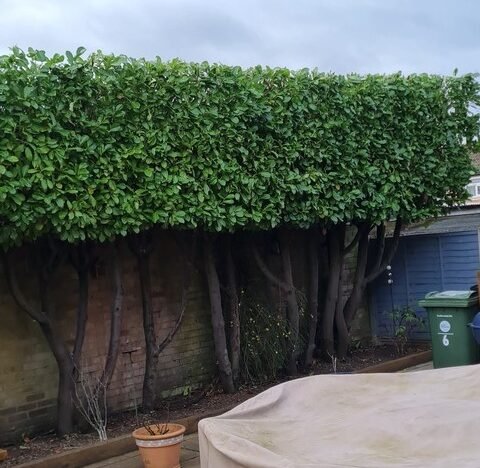
If your hedge is leylandii, keep up with light trimming while it is still green. Cutting back into brown wood usually leaves bare patches that do not recover.

Hedge trimming can be DIY, but the job must fit the garden
A small hedge tidy-up can be a fair DIY job if you can work safely from the ground and the hedge only needs young growth taken off. Tall, wide or overgrown hedges are different because access, waste and cutting accuracy start to matter more.
Use this simple decision path before you get the trimmer out:
- If the hedge is low, narrow and easy to reach, a careful tidy-up may be fine.
- If you need ladders, awkward leaning or work on uneven ground, stop and rethink the risk.
- If the hedge is leylandii or another conifer, be cautious about cutting back to brown wood.
- If the hedge runs beside a pavement, driveway or road, control of falling cuttings matters.
- If the job will create more green waste than you can handle, plan that before the first cut.
- If the hedge needs a hard reduction, use a qualified team with the right kit.
At Treescapes, we would rather give honest advice on whether a hedge is safe to tidy yourself than make a small job sound bigger than it is. Our hedge trimming and shaping work often starts with a plain judgement: can this be kept neat with a light trim, or has it reached the point where it needs proper equipment and careful waste removal?
Clean-up is part of the job, too. A hedge can be cut well and still leave you frustrated if the cuttings end up across the lawn, drive or neighbour’s side of the boundary.
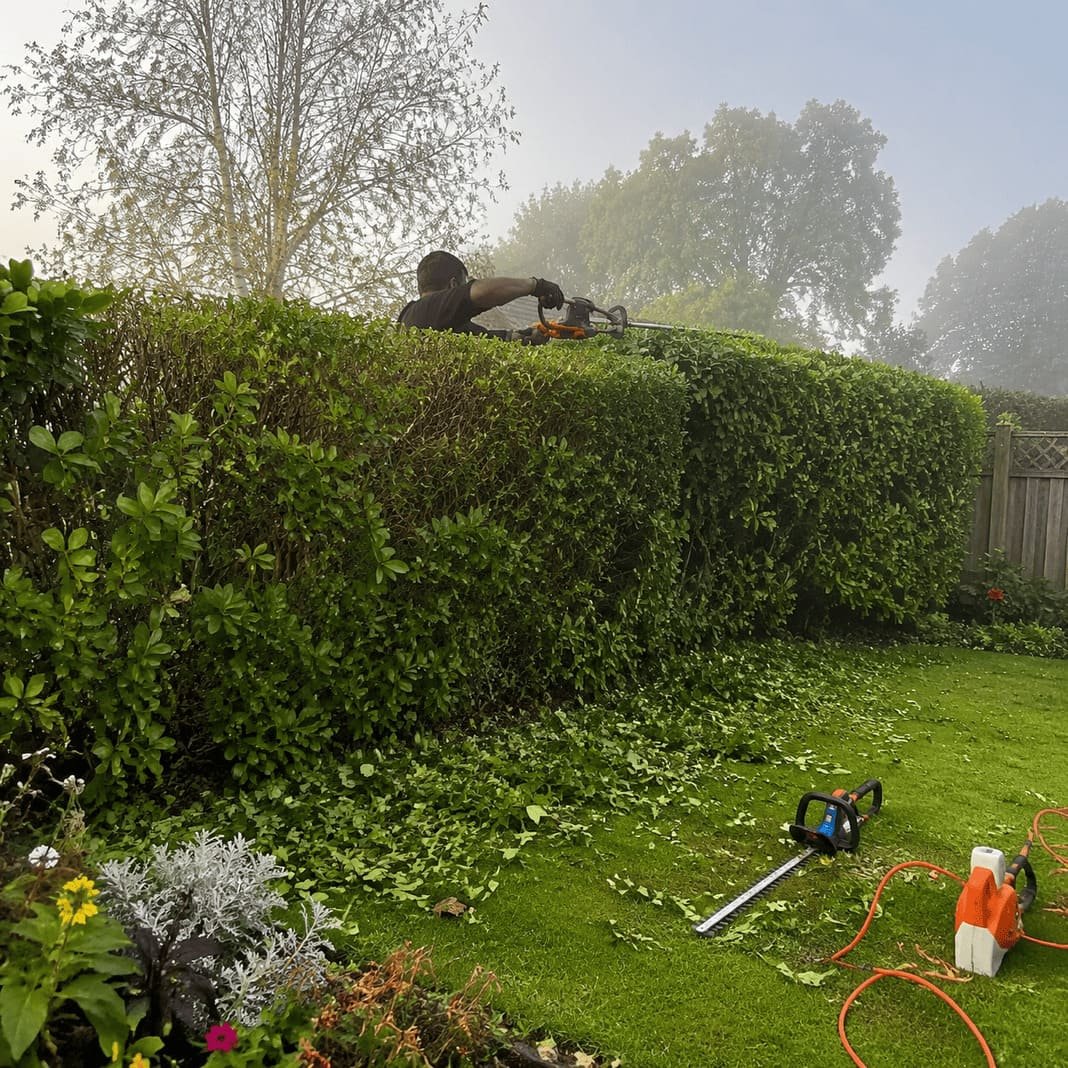
Before any summer cut, check carefully for active nests from ground level. If birds are using the hedge, leave that section until the nesting season has passed.

Local garden hedges need a routine that avoids hard rescue cuts
Gardens around Lower Stondon and Henlow often have mature boundaries, and many homes in North Hertfordshire and Central Bedfordshire use hedges for screening as well as shape. Once a hedge becomes both tall and wide, the cut is no longer just about neatness. Access, waste and plant response all start to set the limits.
Fast-growing conifers near boundaries need planned care because delay narrows your choices. Leave them too long and the green face moves further out, which means a harder cut is more likely to expose bare growth. Slower hedges, such as beech, give you more room to manage the year with one clean trim.
Treescapes Garden Services is a family-run tree surgery and garden services team based near Henlow, so we look at hedges as part of the whole garden, not as a strip of green to shear flat. The right routine keeps the boundary useful, the shape controlled and the waste dealt with properly.
Timing matters, but the bigger win is lighter, regular trimming before the hedge forces you into a harder cut.
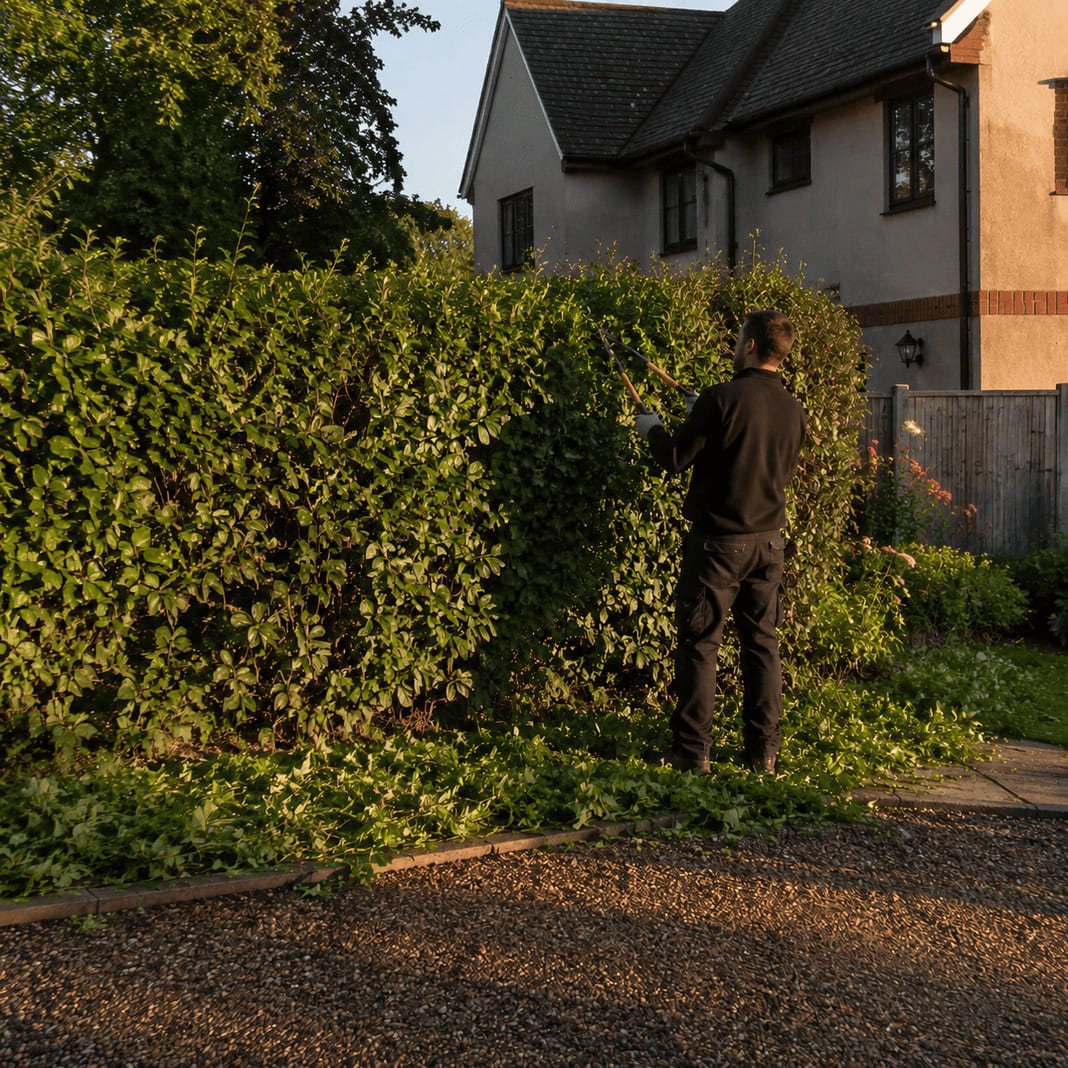
Tell us about your hedge and we will give you honest advice and a clear price.
Request a QuoteQuestions we get asked about hedge cutting
How do I know if my hedge is formal or informal?
A formal hedge is kept to a clear line, with straight sides or a shaped top. An informal hedge has a looser outline and is often allowed to flower, fruit or grow with a softer shape.
What happens if my leylandii has gone brown inside?
Brown inner growth on leylandii will not grow back if you cut into it. We treat the green outer growth as the safe working area and avoid promising a hard reduction that the hedge cannot recover from.
Can an overgrown hedge be reduced in one visit?
Some overgrown hedges can be reduced in one visit, but conifers and very wide hedges may need a more careful plan. The answer depends on the plant, how much green growth remains and how much screening you still want.
Do hedge cuttings need to be removed straight away?
Hedge cuttings are usually best cleared as part of the job because they can be bulky and awkward to handle. Clean removal also lets you see the finished shape properly.
Should I cut the top or the sides first?
For a small DIY trim, the safest rule is to stay within what you can reach securely from the ground. If the top is high or the sides are too wide to control cleanly, the job has moved beyond a simple tidy-up.
This is general information, not professional advice.